
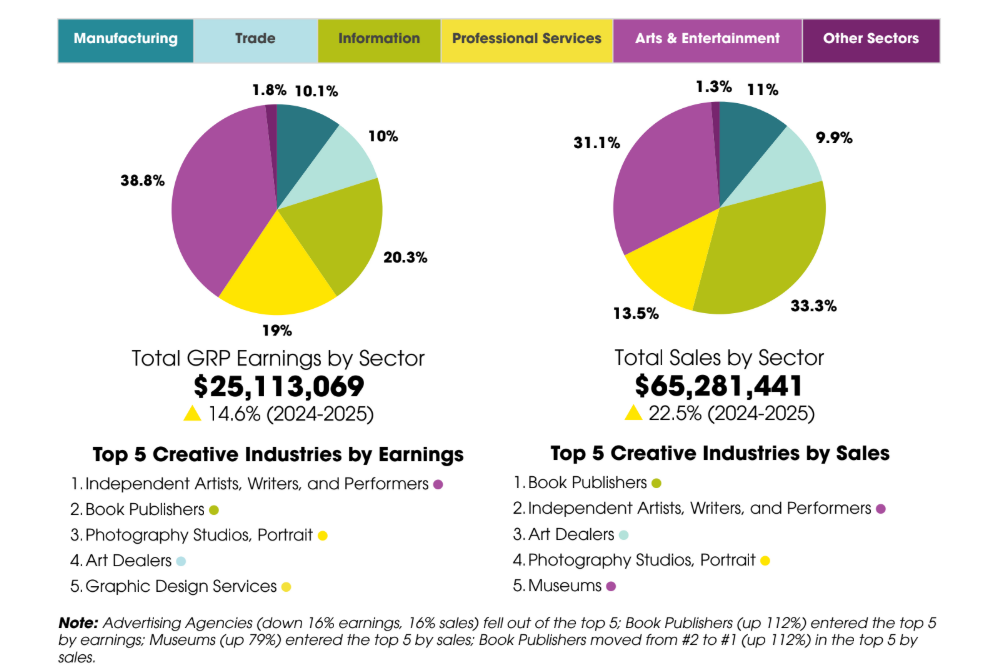
Chart showing Watauga County’s creative economy earnings of $25.1 million and sales of $65.3 million, with increases of 14.6% and 22.5%, respectively, from 2024 to 2025.
Watauga County’s creative community continues to play an important role in the High Country, supporting local businesses, attracting visitors, and creating opportunities for artists, musicians, writers, makers, and other creative professionals. The newly released 2026 Creative Economy Snapshot offers a closer look at the local creative economy, highlighting both its growth and the continued need to support artists as the region recovers from Hurricane Helene.
According to the report, Watauga County’s creative economy saw significant growth between 2024 and 2025. Creative industry earnings increased by 14.6%, reaching more than $25.1 million, while sales rose by 22.5%, reaching approximately $65.3 million. The county’s creative workforce also grew by 2.2%, with an estimated 1,465 creative jobs in 2025.
These figures demonstrate the important role that arts and culture play in the High Country, not only as a source of community connection and creative expression but also as a contributor to the local economy.
A Diverse and Growing Arts Community
Watauga County is home to a vibrant network of cultural organizations, galleries, performance venues, festivals, and educational programs. From the Turchin Center for the Visual Arts and the Appalachian Theatre to the Jones House Cultural Center, Boonerang Music & Arts Festival, and local art crawls, the region offers a wide range of opportunities to experience and participate in the arts.
Independent artists, writers, and performers ranked as the county’s largest creative industry by earnings. Other leading industries included book publishing, photography studios, art dealers, and graphic design services. The report also identified growth in museums, theater companies, motion picture and video production, newspaper publishing, and commercial printing.
Appalachian State University further strengthens the region’s creative economy through its arts, design, music, and media programs, helping educate the next generation of artists and creative professionals.
Together, these creative industries and community resources reflect the breadth of artistic talent that makes the High Country unique.
Celebrating Local Artists and Makers
Craft and traditional making remain important parts of Watauga County’s creative identity. Local creative practices include fiber arts, clay, wood, metal, photography, videography, watermedia, and writing.
The report also highlights measurable growth in craft-related industries. Earnings in ornamental and architectural metalwork manufacturing increased by 15.7% in 2025, while wood household furniture manufacturing grew by 9.7%. Pottery and ceramics, jewelry making, and custom architectural woodwork also contribute to the county’s creative economy.
These industries demonstrate how traditional Appalachian craft practices and contemporary creative work continue to coexist throughout the region. Supporting local artists and makers helps preserve these skills while creating opportunities for creative businesses and careers to grow.
Continuing to Recover After Hurricane Helene
While the creative economy has shown encouraging growth, the report emphasizes that recovery remains an ongoing process for many local artists.
Hurricane Helene significantly disrupted Watauga County’s creative sector in September 2024. Although physical impacts to the arts sector were comparatively limited, many artists lost studio or workspace, fall events were canceled, and seasonal income was disrupted. The cancellations of events such as Valle Country Fair and Buskers Fest contributed to lost income for artists and interruptions for local businesses.
The report notes that artists are booking work again, but some continue to experience lower sales than before the storm.
In response, the Watauga County Arts Council administered grants, opened its facility to meet physical needs, and connected artists and businesses with funding and other resources. These efforts reflect the importance of community support and accessible resources during recovery.
Building Opportunities for the Future
Despite the creative economy’s recent growth, challenges remain. Affordable studio and workspace, shared equipment, training, and business support are among the needs identified in the report. Demand for these resources is already exceeding the capacity of existing facilities, making it difficult for some artists and Appalachian State graduates to establish sustainable creative careers in the High Country.
Continued investment in artists, creative spaces, and local arts organizations can help address these challenges and ensure that the region’s creative community has the resources it needs to thrive.
The 2026 Creative Economy Snapshot offers a reminder that the arts are an essential part of Watauga County’s economic and cultural well-being. Behind every statistic is a network of artists, makers, performers, educators, and creative businesses contributing to the character of our community.
The Watauga County Arts Council encourages community members to support local artists and the arts organizations that help keep creativity thriving throughout the High Country. Whether by attending an event, purchasing locally made artwork, participating in a class, or supporting arts programming, every act of support helps strengthen our creative community.
The 2026 Creative Economy Snapshot uses data provided by Riverbird Research (Lightcast 2026.2), with analysis and interpretation by ArtsAVL, alongside additional local information. Data reflects estimates and a snapshot in time and may be subject to adjustment.
